

How To Lie With Statistics Chapter Summary
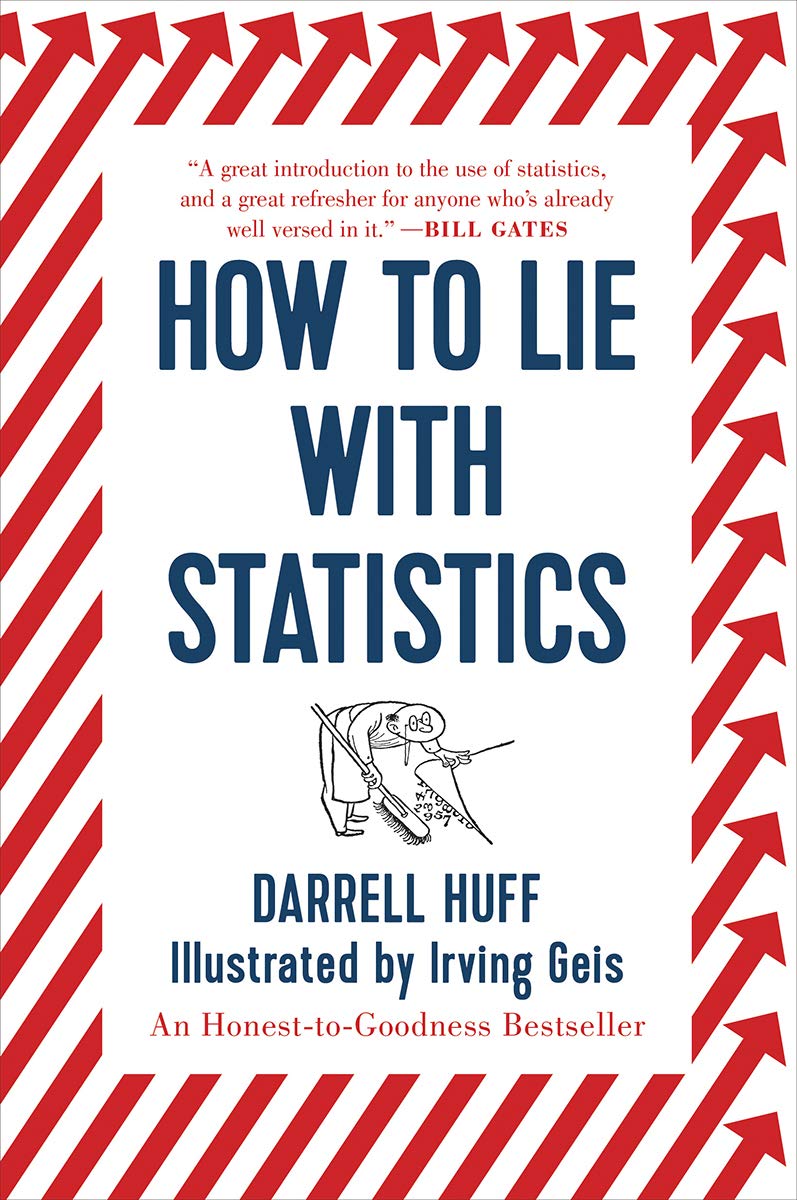
Summary and Review: How to Lie With Statistics
An Honest-to-Goodness Bestseller
26 February 2022 - 4 mins read time
Tags: Statistics

This volume was written by Darrell Huff and published in 1954. Huff is well-known for publishing this all-time-seller and assisting the tobacco lobby equally a statistician.
💡 Thesis of the Book
Statistics is a tool for trickster's to fool the statistically ignorant. By learning how to bandy fact for fiction using quantitative slight-of-paw, y'all'll better prepared to take hold of the swindler's reddish-handed.
"The hush-hush language of statistics, and then appealing in a fact-minded civilisation, is employed to sensationalize, inflate, confuse, and oversimplify."
"This book is a sort of primer in ways to use statistics to deceive… Crooks already know these tricks. Honest men must learn them in self defense force."
💭 My Thoughts
This book is a data literacy classic that has influenced the way many of us interact with number-based claims, specially in the cyberspace era. I know information technology certainly has given me a healthy dose of skepticism anytime I hear a statistically-backed claim or run across a data visualization. In agreement with Tim Harford, I call back this book is a flake besides cynical. You walk away from it with the sense that statistics are a swindler's tool, only it is much more than that. Andrejs Dunkels says it all-time, "It is like shooting fish in a barrel to lie with statistics. It is hard to tell the truth without it." I prefer Harford'southward thesis in The Information Detective, which plants its flag in curiosity rather than cynicism. I exercise observe the ironies surrounding this book rather amusing. Subsequently finishing the volume, I glance at the backcover and had a good laugh. I saw the NY Times and the Atlantic postage stamp their approval on the backcover, which is like the captain of the titanic giving the foreword for a book about driving large boats. However, the real irony lies in what Huff did after writing this book. He was hired by the tobacco industry to manufacture doubt about the relationship between smoking and lung cancer through the use of "statisculation" (to infringe Huff'southward term). In general, this book has a rich history and the principles one can derive from it are essential for navigating a digital mural plagued with misleading information. I recommend it to anybody, regardless of statistical background, and in conjunction with Harford's The Data Detective.
📕 Outline
The chapters are very brief, so I put together an outline for the unabridged book.
- Samples can have bias congenital-in, which distorts whatever conclusions yous describe from information technology (chapter one)
- The trouble with statistical theory is that information technology'due south theory. In practice, random samples rarely exist. They are also costly and infeasible to construct.
- Sampling procedure is more of import than sample size because sampling bias is more than dominant than sampling error.
- In 1936, Literary Digest polled its x million subscribers and concluded the election would be dominated past Republican candidate Landon in a 370-161 victory over Roosevelt, but information technology swung to Roosevelt. The Literary Digest'south subscriber base was a biased sample that skewed heavy Republican. A massive sample size was non plenty to overcome the sampling bias. Moral of the story: sampling process outweighs sample size.
- Yous can derive completely different impressions well-nigh a population simply by changing the measure of central tendency reported (chapter 2)
- The mean is subject area to the influence of outliers, which can inflate the perception of central tendency in a group.
- You need the "little figures" to derive substantive meaning from studies/analyses (chapter 3)
- The sample size, p-value, and measures of dispersion provide crucial context. Don't overlook them.
- Don't let isolated statistical elements influence your thinking. Knowing but plenty to be misled is more dangerous than knowing zero.
- Pay attention to the consistency of measurement, i.due east. the standard error (chapter four)
- For example, an IQ test samples intellect with a certain level of precision. You might describe invalid conclusions from comparisons of individuals that fall within the test's range of error.
- Visualizations are perfect tools for manipulating the message purveyed from data (affiliate 5)
- The announcer special: mapping a one-dimensional comparison into a multidimensional representation (chapter vi)
- Build upward a false conclusion by equating non-equivalent phenomenon (affiliate 7)
- The classic statistical trick: suggest a causal human relationship using correlation (chapter viii)
- When two variables are correlated, always check if both correlate with fourth dimension. Any variables that modify with time will be correlated, but may not be directly related.
- Statisticulation: the use of statistics to manipulate thoughts and emotions (affiliate 9)
- Exist skeptical of statistics, just don't condone them
- The best way to collapse a misleading statistic is to probe information technology with questions (chapter 10)
- Who says so?
- How does he/she know?
- What'south missing?
- Did somebody alter the subject field?
- Does information technology brand sense?
Source: https://richardmathewsii.com/booknotes/how-to-lie-with-statistics
0 Response to "How To Lie With Statistics Chapter Summary"
Post a Comment